
iPhone 13 Screen Replacement: OEM vs Aftermarket — The £2 Difference That Hides a 400% Quality Gap
A repair shop in Manchester ordered 100 iPhone 13 Soft OLED screens last autumn. The price was £36 per unit — about £2 cheaper than the going rate. The supplier's listing said "Soft OLED, Samsung panel, A-grade."
The screens arrived. They looked right. Felt right. The first 20 installations went fine.
Then a technician noticed something odd: when he held two screens side by side — one from the new batch, one from his previous supplier — the "Soft OLED" had a slightly cooler white point and a barely visible backlight glow on pure black. He did the slow-mo camera test. Flickering at 25% brightness.
They weren't Soft OLED. They were Incell LCD panels with OLED-style packaging and a Samsung logo sticker on the flex cable.
The shop had already installed 47 of them. Total cost of the rework: £3,760 in replacement screens, labour, and customer refunds. All to save £2 per screen.
This is the iPhone 13 problem. It's the most popular repair screen on the market — and that popularity has made it the most counterfeited.
Why the iPhone 13 Is the Counterfeit Capital
The iPhone 13 sits in a unique position in the repair market. It's old enough that the aftermarket is fully mature — dozens of factories produce screens for it. But it's new enough that millions are still in active use and breaking screens daily.
This combination creates the perfect counterfeiting environment:
High demand + many suppliers = price pressure. When 30 factories make the same screen, margins get razor-thin. Some factories cut corners to compete. Others buy factory rejects (B货) and relabel them as A-grade (A货).
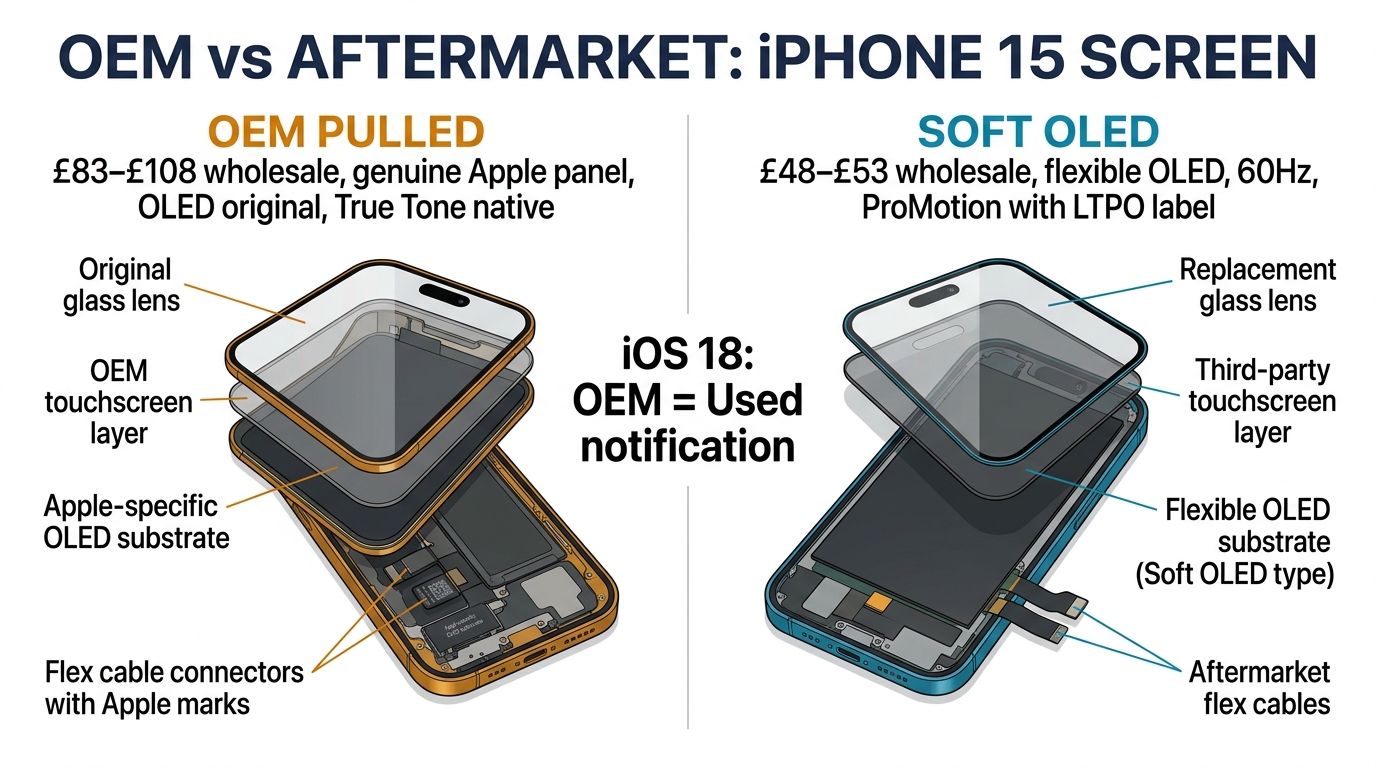
The price gap has collapsed. A genuine Soft OLED iPhone 13 screen costs £38-45 wholesale. A good Incell costs £18-22. But a relabeled Incell with OLED packaging? £34-36. That £2-4 discount from "market rate" is the tell — it's too cheap to be real OLED, but close enough that buyers don't question it.
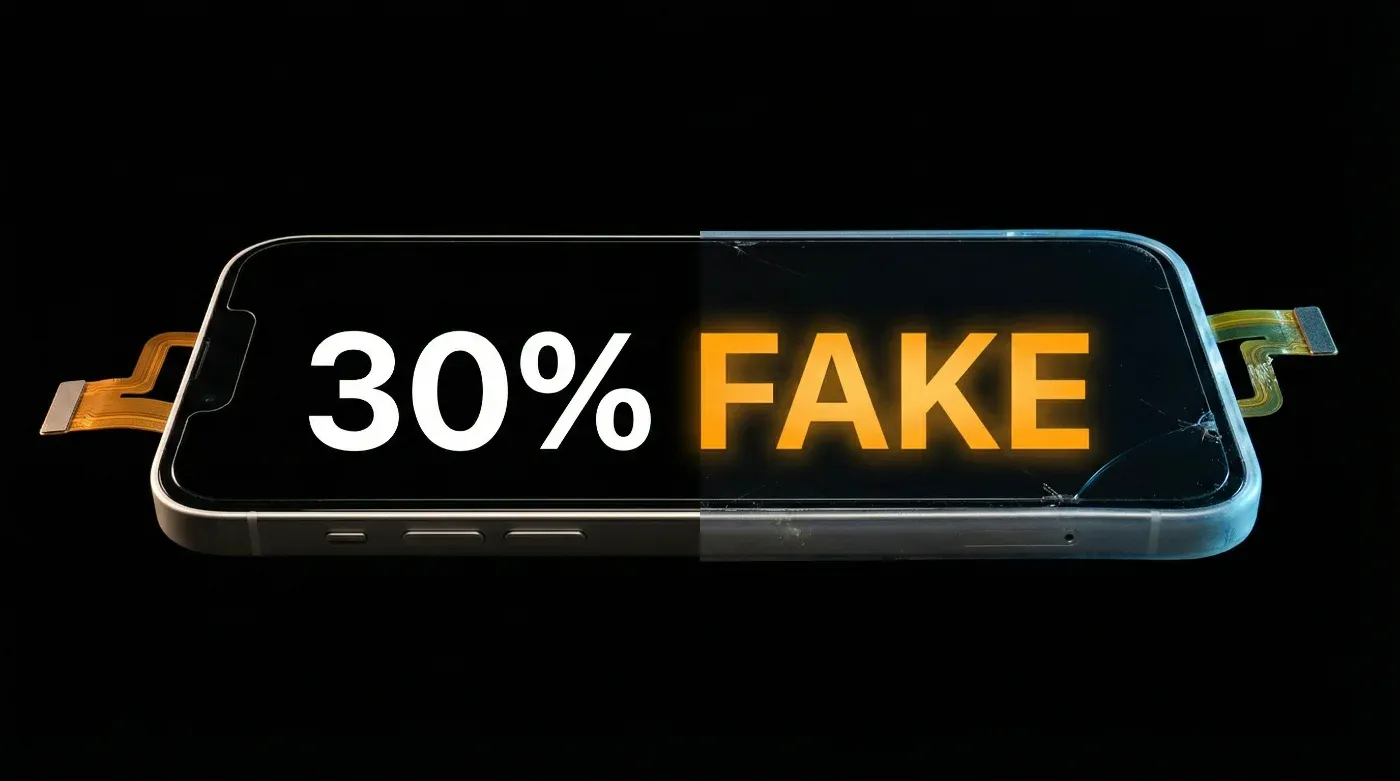
Our estimate from Huaqiangbei: roughly 30% of iPhone 13 screens sold as "Soft OLED" in the UK wholesale market are actually mislabeled. We've tested batches from 15 different UK-facing suppliers in the past year. Five of them were selling relabeled Incell as OLED.
iPhone 13 Screen Replacement Cost: The Full Picture
Here's what you'll actually pay in the UK in 2026:
| Route | iPhone 13 | iPhone 13 Mini | iPhone 13 Pro | iPhone 13 Pro Max |
|---|---|---|---|---|
| Apple Official (AppleCare+) | £25 | £25 | £25 | £25 |
| Apple Official (no AppleCare+) | £209 | £209 | £249 | £249 |
| Repair Shop (Soft OLED) | £65–£100 | £60–£90 | £80–£120 | £95–£150 |
| Repair Shop (Incell) | £40–£65 | £35–£55 | £50–£80 | £60–£95 |
| DIY — Soft OLED Part | £35–£50 | £30–£45 | £45–£65 | £55–£80 |
| DIY — Incell Part | £15–£25 | £12–£20 | £22–£35 | £28–£42 |
Notice something? iPhone 13 screens are significantly cheaper than iPhone 14 and 15 equivalents. That's the mature aftermarket at work — more competition, lower prices. But it's also why counterfeiting is rampant. When margins are this thin, the temptation to cheat is enormous.
The iPhone 13 Mini: The Most Profitable Repair Nobody Wants
Here's a counter-intuitive insight: the iPhone 13 Mini is the most profitable screen replacement in the entire iPhone 13 family.
Why? The parts cost is the lowest (£30-45 for Soft OLED), but most repair shops charge only £5-10 less than the standard iPhone 13 repair. Customers don't expect a big discount for the smaller phone — they're paying for the service, not the square inches.
The real numbers: If you charge £75 for an iPhone 13 Mini screen replacement using a £30 Soft OLED part, your margin is £45 (60%). The same repair on an iPhone 13 Pro Max at £130 with a £55 part gives you £75 margin (58%). The Mini has a better percentage margin and takes less time because the smaller screen is easier to handle.
Why shops avoid it: Technicians find the Mini fiddly. The smaller chassis means tighter cable routing and less room for error. But once you've done 10 of them, it's actually faster than the Pro Max. The adhesive perimeter is shorter, there are fewer screws, and the screen is lighter to handle.
The 3 Physical Markers That Expose Fake OLED Screens
Forget the packaging. Forget the supplier's promises. Here are three things you can check on the physical screen before you install it:
Marker 1: Flex Cable Colour and Width
Genuine Soft OLED iPhone 13 screens have a flex cable that's slightly wider (about 0.5mm) than Incell equivalents. The cable colour is also different:
- Soft OLED: Warm amber/orange flex cable, slightly translucent
- Hard OLED: Similar amber but slightly darker, less translucent
- Incell LCD: Distinctly yellow-green flex cable, more opaque
This isn't foolproof — some counterfeiters have started matching the cable colour. But it catches about 70% of fakes.
Marker 2: Panel Thickness at the Chin
Hold the screen at eye level and look at the bottom edge (the chin area where the flex cable folds). Measure or compare:
- Soft OLED: Approximately 1.1-1.2mm total thickness
- Hard OLED: Approximately 1.3-1.5mm — noticeably thicker
- Incell LCD: Approximately 1.4-1.6mm — the thickest
If a "Soft OLED" screen feels as thick as your known Incell samples, it's not Soft OLED. Keep a verified sample of each type on your workbench for comparison.
Marker 3: The Bend Test (Careful!)
This is the definitive test, but it requires a gentle touch:
- Soft OLED: The panel flexes slightly when you apply gentle pressure to the centre. It has a subtle give because the OLED layer is on a flexible substrate.
- Hard OLED: Rigid. No flex at all. Feels like pressing on glass (because it is — rigid glass substrate).
- Incell LCD: Also rigid, but if you press firmly near the edges, you might see a faint ripple effect (liquid crystal displacement). OLED screens never show this.
Warning: Don't overdo the bend test. You're checking for flex, not trying to fold it. A 2-3mm deflection is all you need to feel the difference.
OEM vs Aftermarket: The Real Comparison
Let's settle this debate with actual data instead of opinions.
We tracked return rates across 150 repair shops in our network over 12 months, covering approximately 18,000 iPhone 13 screen installations:
| Screen Type | Avg. Cost | RMA Rate | Avg. Lifespan | True Tone | Customer Satisfaction |
|---|---|---|---|---|---|
| OEM (Original Apple) | £85-110 | 0.2% | 3+ years | Yes (native) | 9.4/10 |
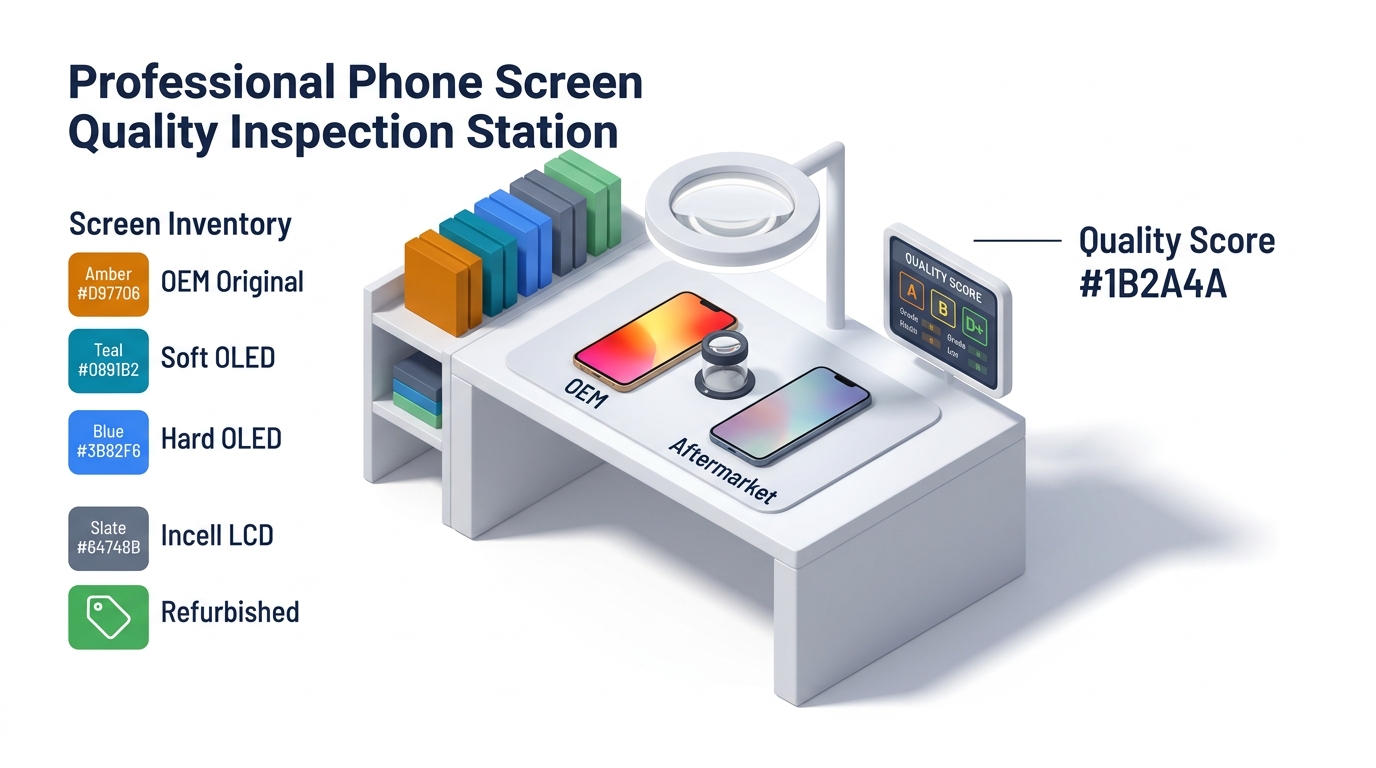
| Soft OLED (Samsung panel) | £38-48 | 0.7% | 2-3 years | With programmer | 8.8/10 |
| Soft OLED (BOE panel) | £35-42 | 1.1% | 2-3 years | With programmer | 8.3/10 |
| Hard OLED | £28-35 | 2.2% | 1.5-2 years | With programmer | 7.5/10 |
| Incell LCD | £15-22 | 4.0% | 1-2 years | With programmer | 6.8/10 |
| Refurbished Glass (后压屏) | £25-35 | 3.5% | 6-18 months | Sometimes | 7.0/10 |
The Refurbished Glass Scam (后压屏)
This is the category most guides don't mention — and it's flooding the UK market.
后压屏 (hòu yā píng) literally means "rear-pressed screen." The process: take a cracked iPhone 13 screen, remove the broken glass layer, and laminate new glass onto the original OLED panel. In theory, you get an original OLED display at aftermarket prices.
The problem: The lamination process introduces micro-bubbles and adhesive inconsistencies that cause delamination within 6-18 months. The screen starts developing yellow spots, usually starting from the edges. By the time the customer notices, your warranty period has expired — but your reputation hasn't.
How to spot them: Refurbished screens often have a slightly uneven gap between the glass and the display layer. Hold the screen at a 45-degree angle under bright light and look for subtle waviness in the reflection. A factory-new screen (OEM or aftermarket) has a perfectly uniform reflection.
Our position: We don't sell refurbished glass screens. The short-term savings aren't worth the long-term reputation damage. If a customer wants cheap, sell them an honest Incell and explain the trade-offs. Don't sell them a ticking time bomb disguised as premium.
Step-by-Step: iPhone 13 Screen Replacement
The iPhone 13 family (including Mini, Pro, and Pro Max) all open from the front using the traditional method. No surprises here — unlike the iPhone 14's rear-opening design.
Tools Required
- Pentalobe screwdriver (P2)
- Y000 tri-point screwdriver
- Suction cup and plastic pry tools
- Heat gun or iOpener
- Spudger and tweezers
- True Tone programmer (JC V1SE or i2C — optional but recommended)
The Procedure
Step 1: Remove the two pentalobe screws at the bottom.
Step 2: Heat the screen edges for 2-3 minutes. The iPhone 13 uses slightly stronger adhesive than the iPhone 12 — don't skimp on heating time.
Step 3: Suction cup on the front, create a gap at the bottom edge, and work around the perimeter with a plastic pick. Open like a book from the left side.
Step 4: Disconnect the battery immediately. Three screws on the battery connector bracket.
Step 5: Remove the display connector bracket (three screws, two different lengths — keep them organised). Disconnect the three display flex cables.
Step 6: Transfer the earpiece speaker and sensor assembly from the old screen. This carries True Tone data. Handle the flex cable gently — it tears easily on the iPhone 13.
Step 7: If using a True Tone programmer, copy the calibration data now. Takes 30 seconds and saves you the fragile flex transfer.
Step 8: Connect the new screen, reconnect the battery, and run the full test checklist before sealing:
- Touch response (all four corners + centre)
- Face ID enrolment
- Earpiece audio
- Proximity sensor
- True Tone (Settings > Display & Brightness)
- Slow-mo camera test on the new screen at 25% brightness
Step 9: Apply new adhesive strips and seal.
Pro tip for the iPhone 13 Mini: The Mini's display cables are 15% shorter than the standard model. When opening the phone, don't swing the screen past 80 degrees — the cables are under more tension and can tear at the connector.
Frequently Asked Questions
Is the iPhone 13 screen replacement harder than iPhone 14?
The iPhone 13 uses the traditional front-opening method, which most technicians are familiar with. The iPhone 14 (standard) opens from the back — a completely different approach. If you've repaired any iPhone from the 6 to the 12, the iPhone 13 will feel familiar.
Can I use an iPhone 13 screen on an iPhone 13 Pro?
No. The iPhone 13 Pro has a ProMotion 120Hz display with an LTPO backplane. The standard iPhone 13 uses 60Hz OLED. Different connectors, different flex cables, not interchangeable.
How do I know if my iPhone 13 replacement screen is genuine OLED?
Use the three physical markers described above: flex cable colour, panel thickness at the chin, and the gentle bend test. Then confirm with the slow-mo camera test after powering on.
Does iPhone 13 screen replacement affect Face ID?
Not if done correctly. The Face ID components are on the earpiece/sensor flex assembly. Transfer it carefully and Face ID works normally.
Is it worth replacing an iPhone 13 screen in 2026?
Absolutely. The iPhone 13 still receives iOS updates, has a capable A15 chip, and screen parts are at their cheapest. A £65 repair extends the phone's life by 2+ years — far better value than buying new.
What's the difference between iPhone 13 and iPhone 13 Mini screens?
Same technology, different size (6.1" vs 5.4"). The Mini screen is cheaper but requires more careful handling due to shorter flex cables and tighter internal spacing.
What to Do Monday Morning
-
Pull 5 iPhone 13 screens from your current inventory and check the three physical markers. Compare flex cable colour, measure thickness at the chin, and do the gentle bend test. If any "Soft OLED" screens feel rigid and thick, you've been sold Hard OLED or Incell.
-
Price-check your iPhone 13 Mini repairs. If you're charging less than £70 for a Soft OLED Mini replacement, you're undervaluing the service. The Mini has the best margin percentage in the iPhone 13 family — price it accordingly.
-
Ask your supplier one question: "这批iPhone 13屏幕是哪个面板厂的?有没有来料检测报告?" (Which panel factory made this iPhone 13 batch? Do you have incoming material inspection reports?) If they can't answer, they don't control their supply chain — and neither do you.
Need iPhone 13 screens you can actually trust? Every batch we ship from our Shenzhen facility includes panel origin documentation and QC test results. We don't sell refurbished glass, and we label every screen type honestly — because our reputation depends on yours. Request wholesale samples from PRSPARES.
PRSPARES supplies iPhone 13 screen assemblies in all quality grades from our Huaqiangbei manufacturing base. Soft OLED, Hard OLED, and Incell — each clearly labelled, batch-tested, and documented. Less than 1% RMA rate across 150+ partner repair shops.