
We get at least two emails a week that go something like this:
"I ordered 20 iPhone SE screens and half of them don't fit. The connector is in the wrong place. What's going on?"
What's going on is the single most common ordering mistake in the phone repair parts industry. And it happens because Apple did something unusual with the iPhone SE line: they released three phones with the same name but three completely different screens.
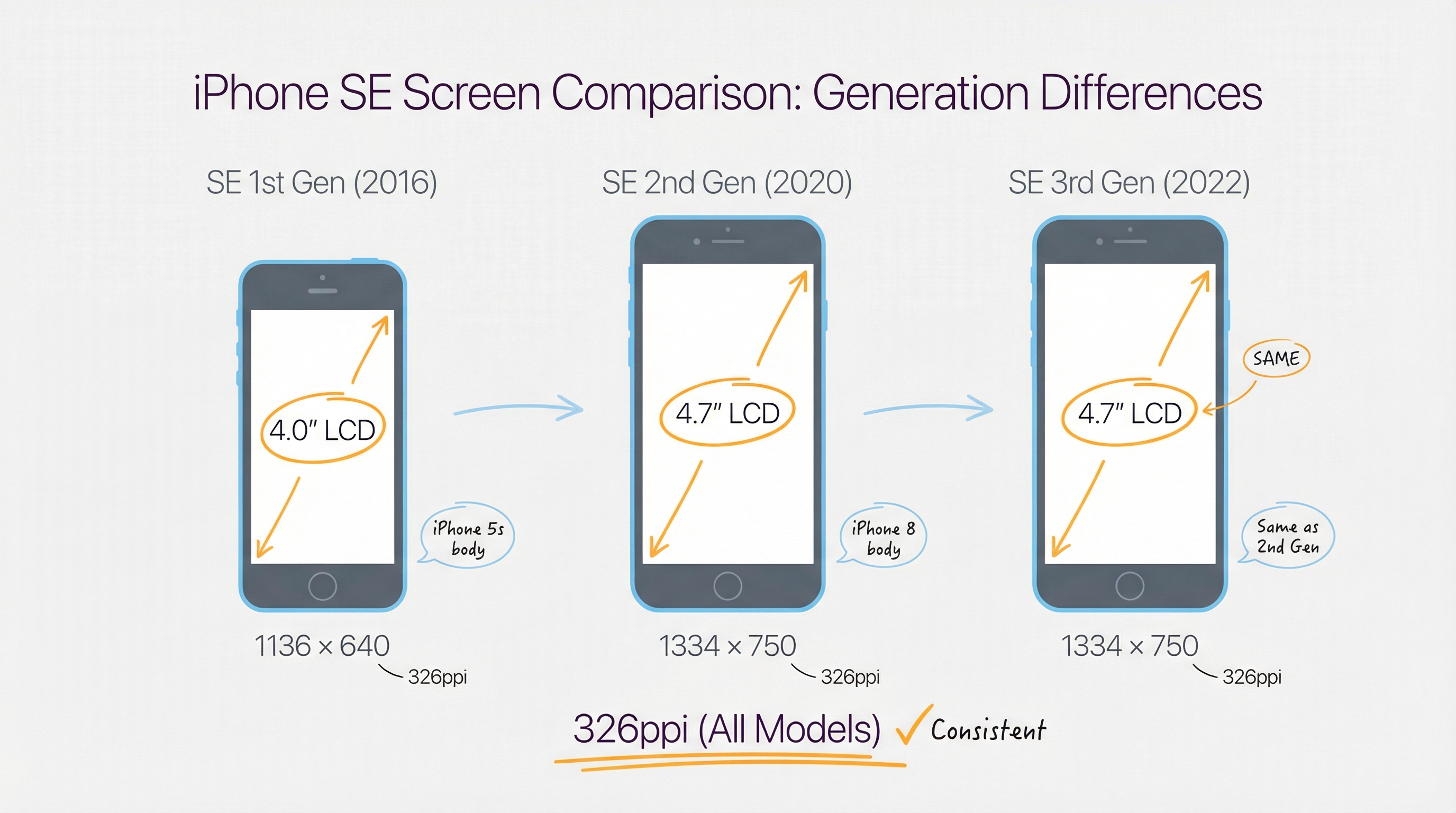
- iPhone SE 1st Generation (2016): 4.0-inch LCD, model A1662/A1723
- iPhone SE 2nd Generation (2020): 4.7-inch LCD, model A2275/A2296/A2298
- iPhone SE 3rd Generation (2022): 4.7-inch LCD, model A2595/A2782/A2784
The 2nd and 3rd gen look identical from the outside. Same 4.7-inch screen, same Home button with Touch ID, same body shape. But here's what nobody tells you: the SE 2nd gen screen is identical to the iPhone 8 screen, and the SE 3rd gen screen is also identical to the iPhone 8 screen. They're interchangeable. The 1st gen, however, uses the iPhone 5S screen form factor — completely different size, different connector, different everything.
This means if you're ordering "iPhone SE screens" without specifying the generation, you're gambling. And at wholesale quantities, that gamble gets expensive fast.
This guide covers all three generations, the exact cross-compatibility between models, and why the iPhone SE is the most profitable budget repair you can offer in 2026.
iPhone SE Screen Replacement Cost: All 3 Generations Compared
Let's start with what you'll actually pay. Prices are for the UK market in 2026:
| Route | SE 1st Gen (2016) | SE 2nd Gen (2020) | SE 3rd Gen (2022) |
|---|---|---|---|
| Apple Official (with AppleCare+) | No longer supported | £25 | £25 |
| Apple Official (without AppleCare+) | No longer supported | £149 | £149 |
| High Street Repair Shop | £25–£45 | £30–£55 | £35–£60 |
| DIY — Quality LCD Part | £5–£10 | £6–£12 | £6–£12 |
| DIY — Budget LCD Part | £3–£6 | £4–£8 | £4–£8 |
Yes, you read that correctly. An iPhone SE screen can cost as little as £3-£6 for the part. These are the cheapest iPhone screens on the market, by a significant margin. The iPhone SE uses basic LCD technology — no OLED, no curved edges, no under-display sensors. It's a flat, rectangular LCD panel with a Home button cutout. Simple to manufacture, simple to replace.
Why the SE 1st gen is slightly cheaper: The 4.0-inch panel uses less material and the tooling has been amortised over a decade of production (the same screen fits iPhone 5, 5S, 5C, and SE 1st gen). Supply is abundant.
Why SE 2nd and 3rd gen cost the same: They use the same screen. Literally the same part. The SE 2nd gen (2020) and SE 3rd gen (2022) both use the iPhone 8 LCD panel with identical dimensions, connector placement, and digitiser layout. If a supplier charges more for "SE 3rd gen" screens versus "SE 2nd gen" screens, they're either confused or padding their margin.
The Cross-Compatibility Cheat Sheet Every Repair Shop Needs
This is the information that saves you money and prevents ordering mistakes. Print this out and stick it next to your workstation:
iPhone SE 1st Generation (2016) screen is compatible with:
- iPhone 5S
- iPhone 5C (with minor bracket differences)
- That's it. Nothing else.
iPhone SE 2nd Generation (2020) screen is compatible with:
- iPhone 8
- iPhone SE 3rd Generation (2022)
- That's it. NOT compatible with iPhone 7 (different 3D Touch module) or iPhone 6S (different size).
iPhone SE 3rd Generation (2022) screen is compatible with:
- iPhone 8
- iPhone SE 2nd Generation (2020)
- Same as above — they're the same screen.
The common mistake: Ordering iPhone 7 screens thinking they'll fit the SE 2nd gen. They won't. The iPhone 7 uses a different 3D Touch haptic layer and the flex cable connector is positioned differently. The screens look almost identical in photos, which is why this mistake happens so often in online ordering.
The supplier trick to watch for: Some suppliers list "iPhone 6/6S/7/8/SE" screens as a single SKU. This is misleading. The iPhone 6, 6S, 7, and 8 all have different screens despite looking similar. Only the iPhone 8 and SE 2nd/3rd gen are truly interchangeable. If a supplier can't distinguish between these models, find a different supplier.
iPhone SE Screen Quality: What £3 Gets You vs What £10 Gets You
Since all iPhone SE screens are LCD, the quality tiers are straightforward. There's no OLED vs LCD debate here — it's all LCD. The question is which LCD.
The £3-£6 Screen (Copy LCD / 国产屏)
These are domestically manufactured LCD panels — not refurbished originals, not pulled from donor phones. They're new panels made by smaller Chinese manufacturers.
What you get:
- Functional touch and display
- Slightly cooler colour temperature than original (blueish whites)
- Lower maximum brightness (350-400 nits vs Apple's 625 nits)
- Touch responsiveness is adequate but noticeably less smooth than original
- Viewing angles are narrower — colours shift at 30+ degrees
What you don't get:
- True Tone (not supported on aftermarket SE screens regardless of price)
- Original colour accuracy
- The same oleophobic coating (fingerprints show more)
Who should use this: Shops offering a "budget repair" tier, or customers who just need a working screen and don't care about colour accuracy. At £3-£6 per unit, even with a 10% failure rate, the economics work.
The £6-£12 Screen (Grade A LCD / A货)
These are higher-quality aftermarket LCDs, often using panels from Tianma (天马) or similar established manufacturers. Some suppliers also offer "refurbished original" screens at this price point — genuine Apple LCD panels that have been removed from donor phones, cleaned, and fitted with new flex cables and backlight modules.
What you get:
- Colour temperature much closer to original (warm whites)
- Higher brightness (500-550 nits)
- Smooth touch response, nearly indistinguishable from original
- Better oleophobic coating
- Wider viewing angles
The refurbished original option: At the £8-£12 price point, you can sometimes find refurbished original Apple LCD panels. These are genuine Apple screens pulled from phones with other damage (logic board failure, water damage to other components). The LCD panel is tested, the polariser is replaced if needed, and a new flex cable is attached. These offer the best colour accuracy but supply is inconsistent — you can't always get them in bulk.
Who should use this: Any shop that wants consistent quality and low return rates. Our data shows Grade A iPhone SE screens have a 0.4% RMA rate — the lowest of any iPhone model we supply.
Why the iPhone SE Is Your Secret Weapon for Shop Profitability
Let's talk numbers. The iPhone SE repair is the most underrated profit centre in the repair industry, and here's why:
The repair economics:
| Metric | iPhone SE (2nd/3rd Gen) | iPhone 14 Pro |
|---|---|---|
| Parts cost (quality) | £6-£12 | £55-£80 |
| Typical customer charge | £35-£50 | £120-£180 |
| Labour time | 10-15 minutes | 25-35 minutes |
| Gross margin per repair | £23-£44 | £40-£125 |
| Margin per minute | £1.50-£4.40 | £1.14-£5.00 |
| RMA rate | 0.4% | 0.8% |
| Risk of damaging phone | Very low | Medium-high |
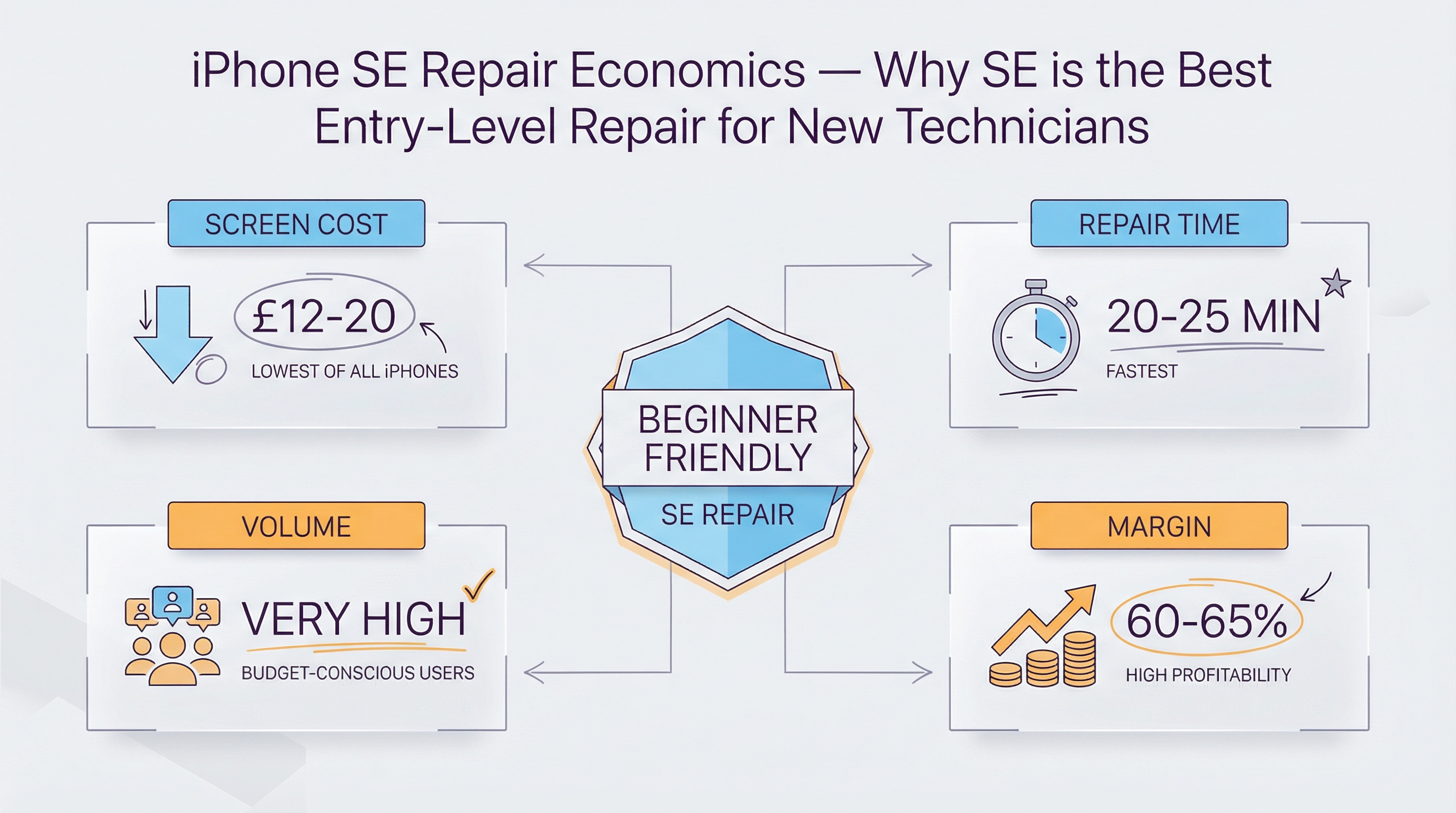
The margin-per-minute is comparable to flagship repairs, with a fraction of the risk. An iPhone SE repair takes 10-15 minutes, uses a £6-£12 part, and has almost zero risk of damaging the phone during repair. There's no Face ID to worry about, no OLED panel to crack, no edge-to-edge glass to navigate. It's a flat LCD with screws.
The volume opportunity: The iPhone SE 2nd gen was Apple's best-selling phone in several markets during 2020. The SE 3rd gen continued strong sales through 2022-2023. There are millions of these phones still in active use across the UK, primarily among:
- Budget-conscious users who chose the SE specifically for its low price
- Business users whose companies issued SE phones as standard
- Older users who prefer the smaller form factor and physical Home button
- Parents who gave their kids an SE as a first smartphone
These users are price-sensitive. They chose the SE because it was affordable. When the screen cracks, they want an affordable repair — not a £149 Apple bill. A £35-£50 repair at your shop is exactly what they're looking for.
iPhone SE Screen Replacement: Step-by-Step for DIY
The iPhone SE (2nd and 3rd gen) is one of the absolute easiest smartphones to repair. If you've never opened a phone before, this is the one to start with.
Tools you'll need:
- Pentalobe screwdriver (P2)
- Phillips #000 screwdriver
- Suction cup
- Plastic spudger or guitar pick
- Tweezers (optional but helpful)
Total toolkit cost: £5-£10. You'll use these tools for years.
The process (15-20 minutes for beginners):
- Power off the phone. Remove the SIM tray.
- Remove the two pentalobe screws at the bottom of the phone, flanking the Lightning port.
- Apply the suction cup to the lower half of the screen. Pull gently while inserting a guitar pick into the gap that forms. Slide the pick around the edges to release the clips.
- Open the phone like a book — the screen hinges from the top. Don't pull it off completely; there are flex cables connecting it to the logic board.
- Disconnect the battery first (always). Remove the metal bracket covering the battery connector and gently pry the connector up with a spudger.
- Remove the metal bracket covering the screen flex cables (3 screws). Disconnect the three flex cables.
- Remove the old screen. Transfer the Home button assembly, earpiece speaker, front camera, and metal brackets to the new screen.
- Reassemble in reverse order. Connect screen flex cables, reconnect battery, close the phone, replace pentalobe screws.
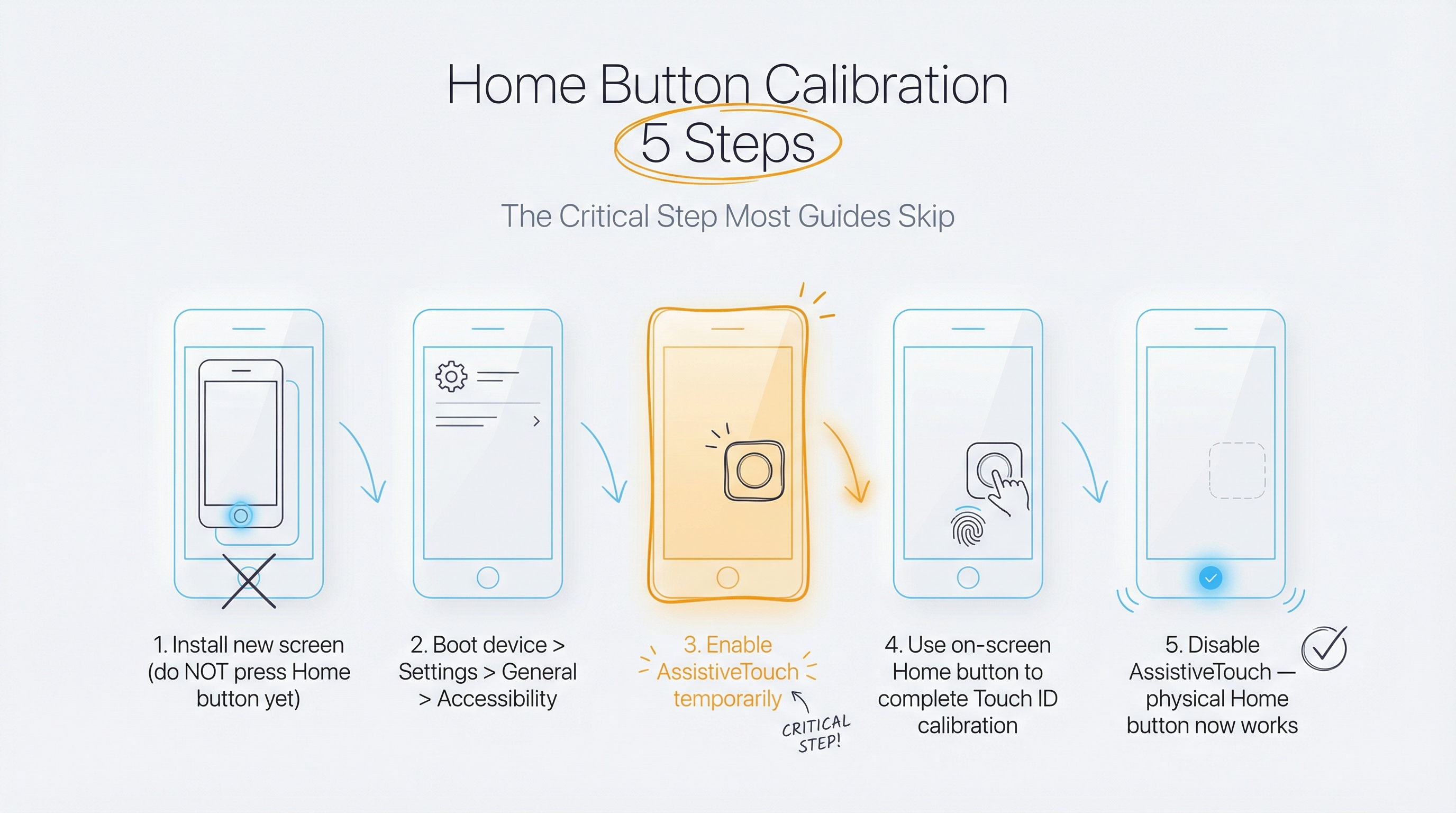
The critical step most guides rush through: Transferring the Home button. The iPhone SE's Home button contains the Touch ID sensor, which is paired to the phone's logic board. If you damage it or use a different Home button, Touch ID will stop working permanently. Handle it gently, and make sure you transfer the rubber gasket that sits around it — this provides the waterproof seal.
The test before closing: Before replacing the pentalobe screws, power on the phone and test:
- Touch response across the entire screen
- Home button / Touch ID
- Front camera
- Earpiece speaker (make a call)
- Proximity sensor (screen should dim when you cover the top)
If anything doesn't work, the most likely cause is a flex cable that isn't fully seated. Power off, disconnect, and reconnect.
iPhone SE 1st Generation: Is It Still Worth Repairing?
The original iPhone SE from 2016 is now a decade old. Apple stopped supporting it with iOS updates at iOS 15. So is it worth replacing the screen?
The honest answer: it depends on the customer.
Yes, if:
- The customer uses it as a secondary phone, music player, or kids' device
- The phone is in otherwise good condition (battery health 80%+)
- The customer specifically wants the tiny 4.0-inch form factor (some people genuinely prefer it)
No, if:
- The battery is degraded (below 80% health)
- The customer needs apps that require iOS 16+ (increasingly common)
- Other components are failing (charging port, speakers)
For repair shops: Keep a small stock of SE 1st gen screens (5-10 units). At £3-£5 per screen, the inventory cost is negligible. Charge £25-£35 for the repair. You'll get a few per month, and the margin is excellent for a 10-minute job.
The nostalgia factor: We've noticed a small but growing trend of customers specifically seeking out iPhone SE 1st gen repairs. Some users genuinely love the compact size and are willing to keep repairing rather than "upgrade" to a larger phone. Don't dismiss these customers — they're loyal and they refer friends.
Frequently Asked Questions
How much does it cost to replace an iPhone SE screen in the UK?
iPhone SE screen replacement costs £25-£60 at a repair shop, depending on the generation and screen quality. DIY replacement costs £3-£12 for the part. Apple charges £149 without AppleCare+ for SE 2nd and 3rd generation (1st gen is no longer supported by Apple).
Are iPhone SE 2nd gen and 3rd gen screens the same?
Yes. The iPhone SE 2nd generation (2020) and SE 3rd generation (2022) use identical screens. They're also the same screen as the iPhone 8. You can use any iPhone 8 / SE 2020 / SE 2022 screen interchangeably.
Can I use an iPhone 7 screen on an iPhone SE 2020?
No. Despite looking similar, the iPhone 7 and iPhone 8/SE screens are not compatible. The 3D Touch module and flex cable connector are different. Always order screens specifically listed for iPhone 8 or SE 2nd/3rd gen.
Will Touch ID work after iPhone SE screen replacement?
Yes, as long as you transfer the original Home button assembly from the old screen to the new one. The Touch ID sensor is paired to the phone's logic board and cannot be replaced with a third-party button. Handle it carefully during transfer.
Is it worth replacing the screen on an old iPhone SE?
For the SE 2nd gen (2020) and 3rd gen (2022), absolutely — these phones still receive iOS updates and the repair cost is very low (£30-£50 at a shop). For the SE 1st gen (2016), it depends on the phone's overall condition and whether the customer needs apps requiring iOS 16+.
What's the difference between a £3 and £10 iPhone SE screen?
The £3 screen uses a domestically manufactured LCD panel with lower brightness, cooler colour temperature, and narrower viewing angles. The £10 screen uses a higher-quality panel (often Tianma) with brightness and colour accuracy much closer to the original Apple screen. Both are functional, but the £10 screen has a significantly lower failure rate (0.4% vs ~10%).
Your Monday Morning Action Plan
If you're a repair shop owner:
-
Check your SE screen inventory. Make sure you're stocking iPhone 8/SE 2020/SE 2022 screens (they're the same part) and NOT accidentally ordering iPhone 7 screens. Verify the model number with your supplier.
-
Price your SE repairs competitively. At £35-£45 with Grade A parts, you're making £23-£39 per repair in 10-15 minutes. Advertise this price — SE owners are price-sensitive and will choose you over Apple's £149.
-
Offer a "screen + battery" bundle. SE batteries are £4-£8 wholesale and take 5 extra minutes to replace. A £50-£60 "full refresh" package is an easy upsell for a phone that's 3-6 years old.
If you're replacing your own screen:
-
Identify your SE generation first. Go to Settings > General > About and check the Model Number. A2275/A2296/A2298 = SE 2nd gen. A2595/A2782/A2784 = SE 3rd gen. A1662/A1723 = SE 1st gen.
-
Order the right screen. For SE 2nd or 3rd gen, any screen listed as "iPhone 8 / SE 2020 / SE 2022" will work. For SE 1st gen, order a screen listed as "iPhone SE 2016" or "iPhone 5S."
-
Don't skip the Home button transfer. This is the one step that can permanently break Touch ID if done carelessly. Watch a video specifically showing this step before you start.
Need screens that fit every time? We label every iPhone SE screen with the exact compatible models — no guessing, no wrong orders. Our Grade A SE screens come at £6-£10 per unit with a 12-month warranty. Request wholesale pricing and we'll include a cross-compatibility chart with your first order.